
Hair health
Hair health is the area of dermatology dedicated to the hair and scalp: hair loss, hair thinning, baldness, dandruff, itching, flaking, and inflammation. It is both medical and aesthetic, because it treats the cause behind the problem and restores density, strength, and appearance to the hair.
At Drummond Dermato, every hair treatment begins with a dedicated consultation, with a scalp exam by trichoscopy and an investigation of the cause. Only then do we build the plan, which usually combines medications, in-office procedures, and technologies. It is this tailored combination that brings the best results.
How the hair and scalp are evaluated
Hair loss has many causes, and treating it without investigating is a waste of time. The hair consultation is a complete dermatology consultation, focused on finding out why the hair is falling out and defining the right hair treatment.
Medical history
When the hair loss started, how it has progressed, family history, pregnancy, menopause, surgeries, medications, diets, stress, and care routine. Every detail guides the diagnosis.
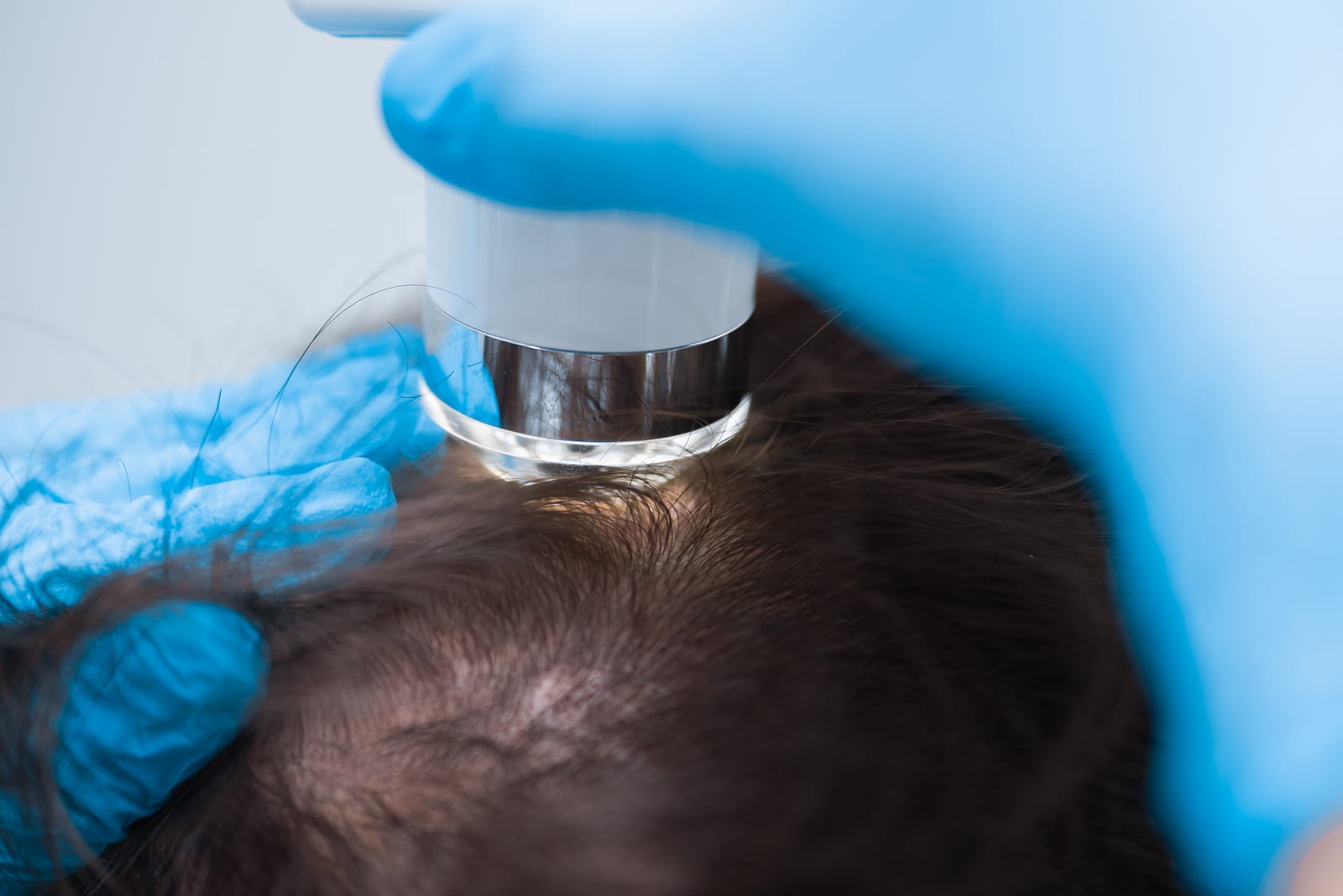
Trichoscopy
An exam of the scalp and hair with a magnifying dermatoscope. It shows hair thickness, the follicles, inflammation, and the signs that distinguish each type of alopecia, painlessly and during the consultation itself.
Additional tests
When needed, we order blood tests (iron, vitamins, thyroid, hormones) and, in specific cases, a scalp biopsy to confirm the diagnosis.
Photographic documentation
Standardized photos and trichoscopy images at the start of treatment, to track progress objectively over the months.
Individual plan
With the diagnosis in hand, we define the combination of treatments, the order, the interval between sessions, and realistic goals for your case.
Follow-up
Periodic follow-up visits with a new trichoscopy and comparison photos, adjusting the plan according to how the hair responds. Hair health is ongoing care.
Main hair and scalp conditions
Androgenetic alopecia
Genetic pattern baldness, which affects both men and women: a receding hairline, a thinning crown, or a wider part, with progressive hair thinning. Two changes happen at the same time: the growth phase shortens, producing ever finer hair, and a chronic microinflammation develops around the follicle. It can be controlled very well with ongoing treatment.
Telogen effluvium
Diffuse, intense shedding that appears weeks after a trigger: childbirth, fever, surgery, a restrictive diet, stress, or nutritional deficiencies. It usually resolves when the cause is treated: the follicle itself is not diseased and, once the trigger is removed, the hair tends to grow back. Treatment serves to support and speed up this regrowth.
Alopecia areata
Round patches of hair loss of autoimmune origin. It requires a precise diagnosis and specific treatment, with close follow-up.
Seborrheic dermatitis
Dandruff, oiliness, itching, and flaking of the scalp. When chronic, the inflammation contributes to hair loss, which is why it is treated at the same time.
Hair loss in women
Hormonal changes, polycystic ovary syndrome, birth control, pregnancy, and menopause have a direct impact on the hair and call for their own investigation.
Fine, weak hair
Hair that lacks volume, breaks easily, or grows slowly, even without obvious hair loss. This is also a sign that the follicles need care.
We also evaluate folliculitis, scarring alopecias, and other scalp conditions. Want to better understand the causes? Read what causes hair loss.
The hair cycle
Each hair is born, grows, rests, and falls out to make way for a new one. Understanding this cycle explains why hair loss happens and what the treatments do.
Anagen
The growth phase. It lasts 3 to 6 years and is genetically determined: the longer it lasts, the more the hair grows. This is when the hair gains thickness and length.
Catagen
A short transition, lasting a few weeks, in which the follicle stops production and prepares to rest.
Telogen
The resting phase. The hair waits 2 to 3 months before falling out, and the follicle stays empty for a while before starting a new hair.
In androgenetic alopecia, the anagen phase shortens with each cycle and the hair grows back finer and finer. In telogen effluvium, a trigger pushes many hairs into the resting phase at once. In both cases, treatment means lengthening the growth phase and bringing forward the follicle’s entry into a new cycle.
The main treatments for hair loss
Depending on the cause, hair treatment combines medications, in-office procedures, and technologies. The best results come from combining these strategies, always according to each patient’s diagnosis and medical history.
Medications
The foundation of many treatments: topical, oral, or sublingual minoxidil, finasteride, dutasteride, and spironolactone, as well as vitamins and minerals when there is a deficiency. The choice of medication, route, and dose is always individualized and monitored.
Hair mesotherapy
Medications applied directly to the scalp, superficially, at the level of the follicle, through small injections with substances such as dutasteride and minoxidil. It delivers the active ingredient exactly where it needs to act.
MMP hair treatment
Microinfusion of drugs into the skin: a device with microneedles creates microchannels in the scalp and delivers the active ingredients directly to the follicles, enhancing the treatment. It adds the stimulus of the microneedles to the action of the medication.
Fotona hair treatment
Two Fotona laser handpieces that work in a complementary way on the scalp: one provides controlled thermal stimulation, which triggers the follicle’s regenerative signaling and brings forward the growth phase, and the other, MarcCo, provides photobiomodulation, which modulates the inflammation around the follicle and improves microcirculation. No incisions, no needles, and no injectable medications, in a comfortable session. See how it works in the video.
Exosomes
The most advanced option in regenerative medicine: regeneration signals applied to the prepared scalp to reactivate the follicles and stimulate hair regeneration, as a complement to the plan. Learn more about exosomes for hair loss.
Scalp treatment
Dandruff, oiliness, and inflammation are treated at the same time, with specific shampoos and lotions and control of seborrheic dermatitis. A healthy scalp is the foundation for hair to grow.
How the laser works on the scalp
In the video, Dr. Alessandra Drummond explains the hair life cycle, the difference between androgenetic alopecia and telogen effluvium, and how two Fotona laser handpieces work in a complementary way: one with controlled thermal stimulation, the other with photobiomodulation, which helps modulate the inflammation around the follicle. She also talks about MMP as a combined option and why hair care is planned over the course of the year.
Controlled thermal stimulation
The first handpiece uses the erbium laser with an energy delivery that heats the scalp in a controlled way, without injuring the skin. The heat spreads to a depth of about 0.5 mm and triggers regenerative signaling: activation of fibroblasts, production of growth factors and extracellular matrix proteins, improved local circulation, and the formation of new blood vessels. This signaling brings forward the hair’s transition from the resting phase to the growth phase.
Photobiomodulation (MarcCo handpiece)
The second handpiece does not heat: it emits a light that is absorbed by the cells and acts on cell metabolism and signaling. It helps modulate the inflammation around the follicle, improves the local environment, and helps the hair stay in the growth phase. Because androgenetic alopecia involves chronic microinflammation, the two handpieces are usually combined in the same session. The procedure is comfortable and needle-free.
Other videos about hair and scalp
How the MMP hair treatment works
Microinfusion of drugs into the scalp: what the session is like and which types of hair loss it is usually indicated for.
Learn more about the MMP hair treatmentExosomes and hair regeneration
What exosomes are, what they are for in the skin and scalp, and how they fit into the hair plan, without exaggeration.
Learn more about exosomesWhy dandruff always comes back
Dr. Murilo Drummond explains the scalp inflammation behind dandruff and why control lies in maintenance.
Learn more about seborrheic dermatitisWhy hair treatment combines strategies
Each approach acts on a different point: medications control the cause, mesotherapy and MMP deliver the active ingredient straight to the follicle, the laser reduces inflammation and stimulates growth, and exosomes support regeneration. In androgenetic alopecia, for example, it is common to combine at-home treatment (minoxidil and oral medication) with MMP and laser sessions. In effluvium, the priority is to correct the trigger and speed up the hair’s recovery. The right plan depends on the diagnosis, and that is what we define in the consultation.
That is why we work with annual hair protocols: diagnosis in a consultation with digital trichoscopy, a combination of treatments, and maintenance planned over the course of the year. With baldness, it is not about a single session but about long-term care. This also applies to people who have had a hair transplant: the surrounding hair remains subject to the condition and needs to stay in treatment.
When to see a dermatologist
- You are seeing more hair on your pillow, in the drain, or in your brush.
- You notice your hair is finer, sparser, or has less volume.
- You have noticed a receding hairline, a thinning crown, or a wider part.
- You had intense hair loss after childbirth, surgery, illness, or a restrictive diet.
- You live with dandruff, itching, or flaking of the scalp.
- You have a family history of baldness and want to prevent it.
- You have already tried products on your own and saw no results.
A gradual result, at the pace of the hair
Hair grows in cycles, which is why the response to hair treatment is progressive: hair loss usually decreases first, in the first few weeks, and gains in density and thickness appear over 3 to 6 months, with continued progress after that. In genetic pattern conditions, treatment is a matter of maintenance, to preserve the result over the years. We track progress with photos and trichoscopy, and adjust the plan according to each person’s response. Without exaggerated promises: realistic expectations, defined in the consultation.
Everything you need to know
Can hair loss be cured?
It depends on the cause. Temporary hair loss, such as effluvium, usually resolves when the trigger is treated. Androgenetic alopecia has no cure, but it can be controlled very well with ongoing treatment, which preserves and restores density.
What is trichoscopy, and does it hurt?
It is an exam of the scalp with a magnifying dermatoscope, performed during the consultation itself. It does not hurt, requires no preparation, and shows details of the hair and follicles that the naked eye cannot see.
Are minoxidil and finasteride safe?
They are well-established medications and are safe when prescribed and monitored by a physician, who defines the route (topical, oral, or sublingual) and the dose, and monitors the response and possible side effects.
Do mesotherapy and MMP hurt?
The discomfort is mild and well tolerated. They are superficial applications, performed in the office in a few minutes, with no downtime.
How soon will I see results?
Hair loss tends to decrease in the first few weeks, and gains in density appear between 3 and 6 months, because hair grows in cycles. Consistency is what secures the result.
Do I need tests?
Often, yes. Hormonal changes, iron deficiency, vitamins, and thyroid are among the common causes of hair loss, and tests help define the right treatment.
Is it for both men and women?
Yes. Hair loss affects both, with different causes and patterns, and hair treatment is designed for each case, including during menopause and after childbirth.
What is the Fotona MarcCo handpiece?
It is one of the two Fotona laser handpieces used in hair treatment. It performs photobiomodulation: a low-intensity light that helps modulate the inflammation around the follicle, activates the hair bulb, and improves local blood flow. The other handpiece, an erbium laser, provides controlled thermal stimulation that activates the follicle’s regenerative signaling and brings forward the growth phase; the two are usually combined in the same session. It is comfortable, needle-free, and involves no downtime, and it is part of the hair plan.
Do anti-hair-loss shampoos work?
Shampoos care for the scalp and help control dandruff and oiliness, but on their own they do not treat the cause of hair loss. They serve as support within a hair treatment defined by the dermatologist.
Does the hair laser hurt?
It usually does not hurt. The heating from the first handpiece is controlled, and photobiomodulation does not heat. The session is comfortable, with no needles and no anesthesia, and you return to your routine right afterward.
I had a hair transplant. Do I need to continue treatment?
Yes. A transplant repositions hair, but it does not change the underlying condition: the surrounding hair remains subject to thinning and needs ongoing care to preserve density and the result.
Why is hair treatment annual?
Because hair responds at the pace of its cycle: the growth phase takes months to reorganize, and androgenetic alopecia is chronic. That is why we build annual protocols, with diagnosis, a combination of treatments, and maintenance planned over the course of the year.
Hair treatments in Barra da Tijuca and Ipanema
Hair treatments are available at both Drummond Dermato locations in Rio de Janeiro. In Barra da Tijuca, the clinic is at Av. das Américas, 3200, sala 112. In Ipanema, at Rua Visconde de Pirajá, 540, sala 314. At both, the treatment is performed by dermatologists from our team, after a consultation that evaluates the scalp and hair and defines the protocol.
Where to get hair loss treatment in Rio de Janeiro?
At Drummond Dermato, in Barra da Tijuca or Ipanema. Book your consultation via WhatsApp and choose the location closest to you.
Find the cause and restore your hair
Consultation with a dermatologist in Ipanema or Barra da Tijuca, with trichoscopy and a hair treatment plan designed for you.
Book via WhatsApp